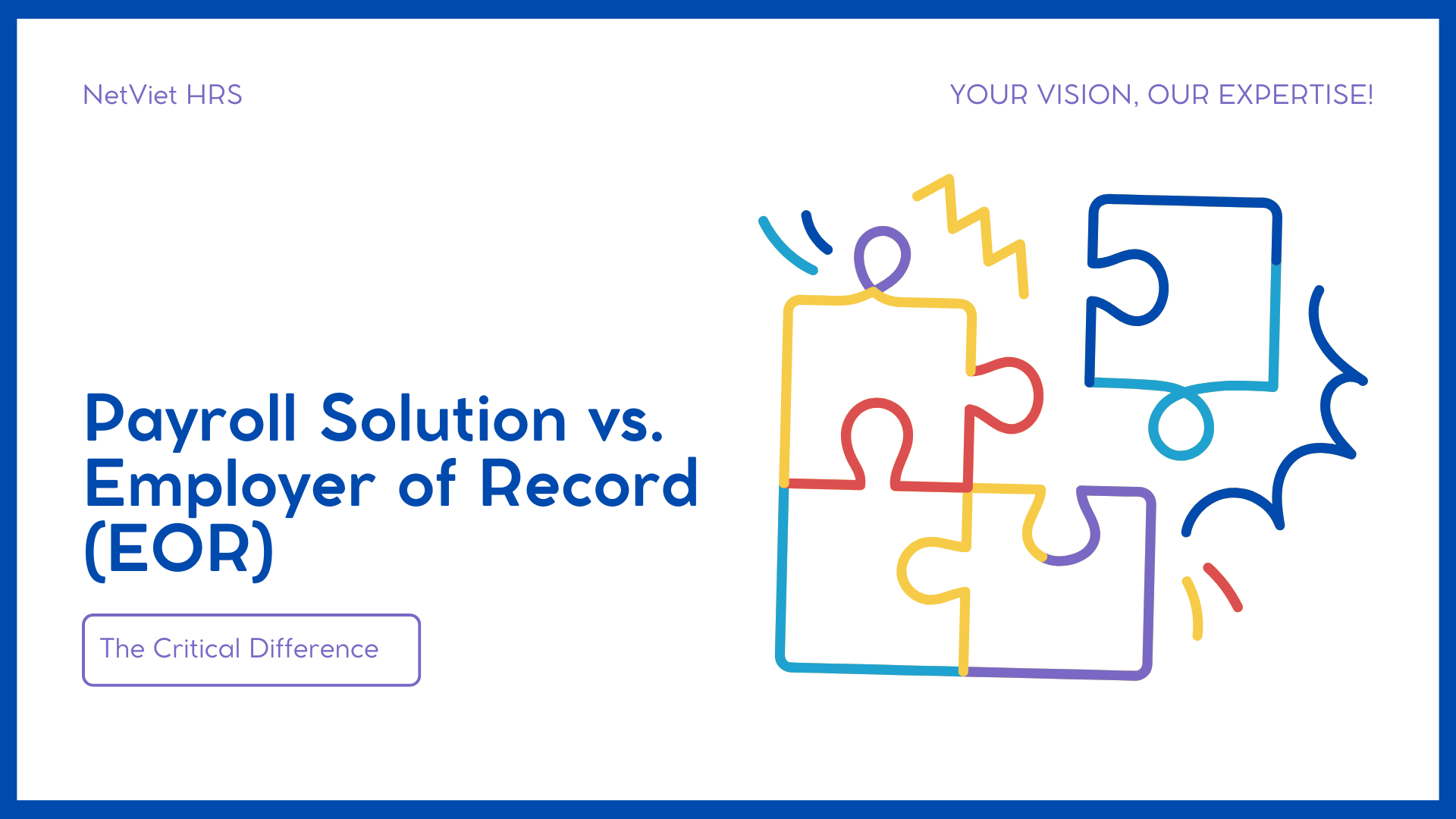
As businesses scale and look to tap into the global talent market, the question of how to pay international employees quickly, accurately, and compliantly becomes paramount. The discussion often centers around two distinct models: a dedicated Payroll Solution (or payroll provider) and an Employer of Record (EOR).
While both services handle the movement of money, they exist at opposite ends of the employment responsibility spectrum. Choosing the right one is not just a matter of cost—it’s a crucial strategic decision that defines your company’s legal liability, speed of expansion, and administrative overhead.
For companies seeking clarity on their global HR strategy, here is a detailed breakdown of the fundamental differences between an EOR and a traditional payroll provider.
Table of Contents
ToggleThe Core Distinction: Who is the Legal Employer?
This is the single most important difference and the foundation upon which all other service differences rest.
The Employer of Record (EOR): The Legal Employer
An EOR is a third-party organization that legally employs workers on your behalf in another state or country. The EOR becomes the official legal employer for all employment-related purposes, including payroll, taxes, benefits, and local compliance.
- Risk Transfer: Because the EOR is the legal employer, they assume the majority of legal responsibility and liability associated with employment. They handle employment contracts, manage statutory benefits, and ensure adherence to local labor laws, effectively shielding your company from the risk of non-compliance.
- No Entity Required: The core value of the EOR is its ability to hire employees in a location where your company has no registered legal entity, enabling rapid, compliant expansion.
The Payroll Solution: The Administrative Partner
A Payroll Solution is a service that focuses solely on the mechanical task of processing compensation. The solution calculates gross-to-net pay, withholds taxes, processes remittances, and issues payments.
- Risk Retention: When using a Payroll Solution, your company remains the legal employer. The provider is merely an administrative vendor. You retain the full responsibility for the employment relationship, including drafting compliant contracts, adhering to local labor codes, and managing legal disputes.
- Entity Required: A Payroll Solution is designed for companies that already have a local legal entity established in the country where the employee is based.
Scope of Services: Transactional vs. Comprehensive
The scope of services offered highlights the difference between a tool and a full partnership.
| Aspect | Payroll Solution | Employer of Record (EOR) |
| Legal Employer | No (Your Company is the Employer) | Yes (EOR is the Legal Employer) |
| Legal Entity | Required (You must establish one) | Not Required (EOR uses its own) |
| Primary Focus | Transactional processing of payments. | End-to-end management of the employment relationship. |
| Risk/Liability | Retained by your company. | Transferred to the EOR. |
| Employment Contracts | Managed and drafted by your company. | Drafted, signed, and managed by the EOR for local compliance. |
| HR & Benefits | Limited to administrative features (e.g., time tracking). | Full administration of statutory and supplemental benefits, plus localized HR support. |
The EOR’s Comprehensive Scope
The EOR model provides a holistic, plug-and-play solution to international hiring, extending far beyond simple pay processing. The EOR’s responsibilities include:
- Bypassing Entity Setup: The EOR uses its own pre-existing legal entity in the host country, eliminating your need to establish a foreign subsidiary, which accelerates time-to-market from months to days.
- Contract and Compliance Management: The EOR drafts, signs, and manages all employment contracts, ensuring they are 100% compliant with local labor codes.
- Full HR and Benefits Administration: The EOR administers mandatory and supplemental benefits (health insurance, pensions, paid leave) and provides localized HR support.
- Risk Transfer: The EOR absorbs the legal liability for compliance errors, employment disputes, and worker misclassification.
Read more: Employer of Record in Vietnam
The Entity Requirement and Global Expansion
The time and cost associated with establishing a foreign legal entity (a subsidiary or branch) is often the biggest bottleneck for global expansion.
EOR: The Fast Track
The EOR model is specifically engineered to eliminate the need for an entity. This allows businesses to:
- Test New Markets: Quickly hire talent in a new region to gauge market demand without committing to major infrastructure investment.
- Access Global Talent: Hire the perfect candidate anywhere in the world immediately, regardless of where your company is registered.
- Maintain Focus: Your internal team focuses on core business operations, while the EOR manages the international administrative burden with a single, consolidated process.
Read more: Hire and Manage a Remote Employee in Vietnam Without a Local Entity
Payroll Solution: The Established Path
A Payroll Solution is best suited for organizations that:
- Are Already Established: Companies with an existing, well-funded, and stable legal entity in the country.
- Have Internal Expertise: Companies with strong in-house HR and legal teams capable of independently managing the complexities of the local labor code.
If your company attempts to use a Payroll Solution to pay an employee in a country where you lack a legal entity, you risk creating a “permanent establishment,” triggering significant corporate tax obligations and misclassification risks—a liability the EOR model is explicitly designed to avoid.
Read more: Payroll vs. Full-Cycle HR Outsourcing
Conclusion: Matching the Solution to Your Strategy
Choosing between an EOR and a Payroll Solution comes down to whether you are looking for an administrative tool or a complete legal framework for employment.
For businesses that require transactional efficiency and already possess the necessary legal infrastructure and internal compliance expertise, a dedicated Payroll Solution is often the more cost-effective choice for long-term operations.
However, for companies prioritizing speed, risk mitigation, and flexibility—especially those making their first entry into a new market or hiring remote talent across multiple jurisdictions—the Employer of Record is the superior strategic partner. The EOR removes the friction of local entity establishment and transfers critical legal liability, ensuring your business can focus on what matters most: growth.
———————————————-
NetViet offers comprehensive HR solutions for businesses entering or expanding in the Vietnamese market. Established in 2000, NetViet provides expert, seamless, and compliant HR solutions.
Follow NetViet for the latest industry updates and more:
- Phone: +84 28 6261 7310
- Email: info@netviet.com.vn
- Website: www.netviet.com.vn
- Facebook | LinkedIn | Threads